A woman, her head covered, like she was on her way to a temple, praying aloud for the welfare of her family, like at a temple, walked past me and entered the chamber that is believed to house the grave of Akbar. The unconventionally plain walled chamber in fact houses the cenotaph of Akbar the Great.
The tainted spot where tourists test the 'Mughal Telephone'.
Completed in around 1613, the mausoleums built to Abkar's syncratic taste, is believed to be the first Indian monument to have included the 'four minaret' design today associated with Taj Mahal.
In most of the images of the mausoleum drawn by early western visitors to this site, the minarets look damaged with the top part missing in all minarets, even as late as 1875. [ref. images at
columbia.edu]
 |
| by William Hodges, 1783 |
 |
| The mausoleum of Akbar at Sikandra, shown both in plan and in elevation; Jaipur style, c. 1780-1800* |
According to 'A Handbook to Agra and the Taj, Sikandra, Fatehpur-Sikri and the Neighbourhood' by E. B. Havell, the minarets were believed to have been broken by Jats. In the popular narrative of Indian History, British looted the golden bird that was India, no mention is made of the facts like it was Jat chieftains who looted the silver gates of Taj Mahal in 1764. Maybe the reasoning being, that loot at least stayed and circulated in India. The local Muslim guides of Agra do mention this history to casual visitors but the history books in schools continue to quarantine parallel narratives, dissolving all little details.
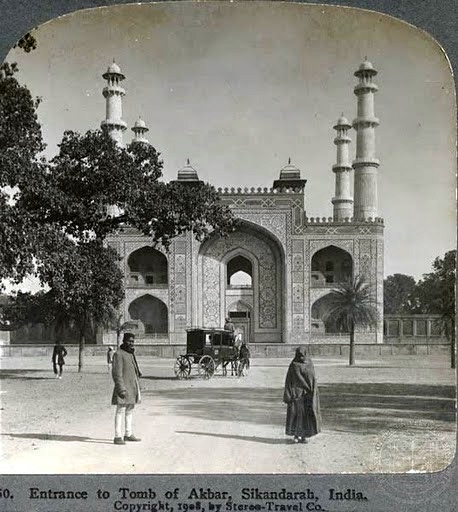
Looking at the photographs,old and new, of the minarets, I wondered when and who got them re-built.
 |
| Repaired minarets in 1908. |
In around 1906, Lord Curzon, of the great Indian famine fame, as one of his last acts in India,, had the minarets of Sikandra re-built and got rid of what he called an 'aesthetic eyesore'.
-0-


Comments
Post a Comment
I always like to hear back :)
However, irrelevant comments and irrelevant links will not be published. Needless to say, same goes for abusive comment and spam. Leaving back links related to the topic is encouraged. I know it can be tempting but try not to leave your email ids, phone nos and CVs in the comment.