
Basohli Paintings evolved in the 17th and 18th centuries as a distinctive style of painting by fusion of Hindu mythology, Mughal miniature techniques and folk art of the local hills. The painting style derives its name from the place of its origin - hill town of Basohli about 80 Km. from the centre of district Kathua in the state of Jammu & Kashmir.
This style of painting was first introduced to the world in the annual report (1918-19) of the Archaeological Survey of India published in 1921. At that time this style was yet to be properly categorized and studied.
Ananda K. Coomaraswamy, who was first to publish them, in Rajput Paintings in 1916, wrote about this style of painting believing it to be Jammu style. Discussing these Jammu paintings, Coomaraswamy observed:
Collected the following beautiful images from The J&K Bank 2008 Annual Calendar
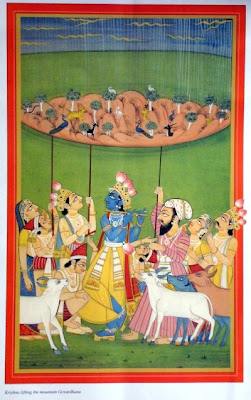

Radha giving butter-milk to Krishna Krishna lifting the mountain Govardhana

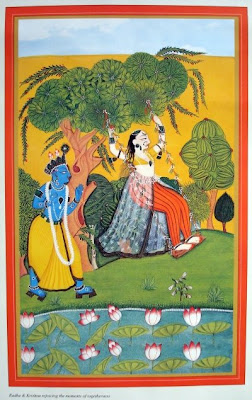
Radha and Krishna rejoicing the moments of togetherness The holy family of Parvati and Shiva


The vigil of the Expectant heroine Utkanthita Brahma, Vishnu and Mahesh paying homage to Trimurti
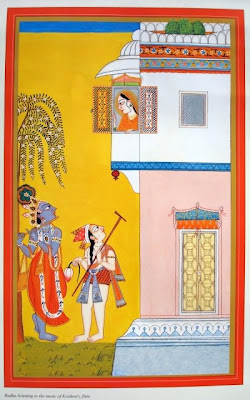

Naiyka of Ragamala awakening the Nayak Radha listening to the music of Krishna's flute

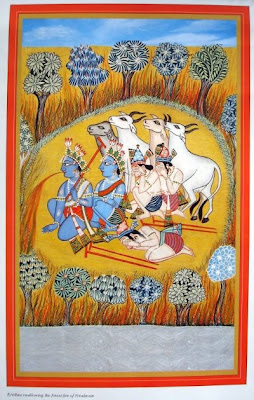
Krishna swallowing the forest fire of Vrindavan Radha holds the restless calf while Krishna is milking a cow
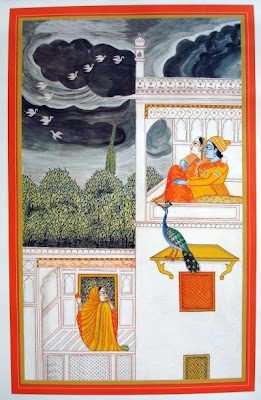
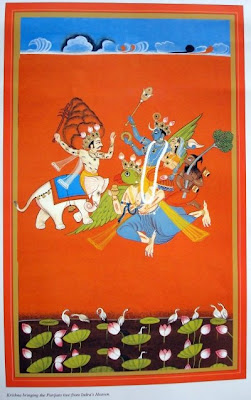
Krishna bringing the Parijata tree from Indra's Heaven View from the window
(Name of artists(not in any order): Lalit Kumar Dogra, Surinder Singh Billawaria, Sohan Singh Billawaria, Dharam Pal, Dheeraj Kapoor, Sona upadhaya, Shakeel Ahmed Raza, Arun Dogra, M.K. Wadhera and Sushil Padha)
You can check out these links if you are interested in knowing more about the art and history of Basohli Paintings:
Centres of Pahari Painting By Chandramani Singh
-0-
This style of painting was first introduced to the world in the annual report (1918-19) of the Archaeological Survey of India published in 1921. At that time this style was yet to be properly categorized and studied.
Ananda K. Coomaraswamy, who was first to publish them, in Rajput Paintings in 1916, wrote about this style of painting believing it to be Jammu style. Discussing these Jammu paintings, Coomaraswamy observed:
The Jammu are well and vigorously designed often with a decorative simplicity very suggestive of large scale mural art. In several examples there reappears that savage vitality which has been already remarked in the early Rajasthani raginis, but it is here associated with more exaggeration and with a strange physical type, the peculiar sloping forehead and very large eyes are especially characteristics of some of the portraits..the coloring is hot. Silver is used as well as gold. A remarkable feature is the occasional use of fragments of beetle's wings to represent jewelery, and by the peculiar character of the architecture, with turrets, paneled doors, latticed windows and plinths ending in grotesque heads...Krsna and Radha or Mahadeva and Uma play the parts of hero and heroine.The most popular themes of Basohli Paintings come from Shringara literature like Rasamanjari or Bouquet of Delight ( a long love poem written in 15th century by Bhanudatta of Tirhut Bihar ), Gita Govinda and Ragamala. These paintings are marked by striking blazing colors, red borders, bold lines and rich symbols. The faces of the figures painted are characterized by the receding foreheads and large expressive eyes, shaped like lotus petals. The painting themselves are mostly painted in the primary colors of Red, Blue and Yellow.
Collected the following beautiful images from The J&K Bank 2008 Annual Calendar


Radha giving butter-milk to Krishna Krishna lifting the mountain Govardhana


Radha and Krishna rejoicing the moments of togetherness The holy family of Parvati and Shiva


The vigil of the Expectant heroine Utkanthita Brahma, Vishnu and Mahesh paying homage to Trimurti


Naiyka of Ragamala awakening the Nayak Radha listening to the music of Krishna's flute


Krishna swallowing the forest fire of Vrindavan Radha holds the restless calf while Krishna is milking a cow


Krishna bringing the Parijata tree from Indra's Heaven View from the window
(Name of artists(not in any order): Lalit Kumar Dogra, Surinder Singh Billawaria, Sohan Singh Billawaria, Dharam Pal, Dheeraj Kapoor, Sona upadhaya, Shakeel Ahmed Raza, Arun Dogra, M.K. Wadhera and Sushil Padha)
You can check out these links if you are interested in knowing more about the art and history of Basohli Paintings:
- Indian Govt. website on Kathua (the place of origin of this painting style)
- A press release on an installation of Basoli paintings held in 2003 at Metropolitan Museum, New York
- You can check out these images in a video presentation too
Centres of Pahari Painting By Chandramani Singh
-0-
Comments
Post a Comment
I always like to hear back :)
However, irrelevant comments and irrelevant links will not be published. Needless to say, same goes for abusive comment and spam. Leaving back links related to the topic is encouraged. I know it can be tempting but try not to leave your email ids, phone nos and CVs in the comment.