
The Japanese left-leaning film critic Akira Iwasaki narrates a story connected to the filming of Rashomon. “While Kurosawa’s staff was at a loose end in its Kyoto hotel waiting for the completion of an open air set…they saw a 16 mm film of an expedition to Africa. One shot showed a lion staring at the cameraman from the edge of the jungle. “Look, Mifune!” cried Kurosawa. “ That’s how Tajomaru (the bandit) should be!” in that instant, he had seen the bandit Tajomaru as he was to appear in the film, peering out at the woman with piercing eyes from the bamboo grove.
Iwasaki also tells how they all went to see a film featuring a black panther at the local cinema on the recommendation of the actor who played the husband (Masayuki Mori). “When the panther at last appeared, Machiko Kyo, the actress who played the part of the young wife, covered her face with her hands in alarm. It was this gesture that crystallized in Kurosawa’s mind the image of Masago, confronted by two men fighting over her like wild beasts in the thicket.”
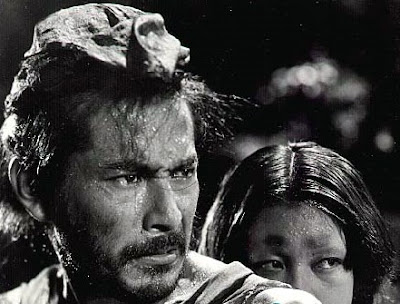 Image credit:found the poster at movietreasures.
-0-
Toshiro Mifune's raw physicality was later used to great effect by Hiroshi Inagaki for his Samurai Trilogy (1954-56).
-0-
Recommended read:
Film Criticism and The Study of Cinema In Japan: A Historical Survey By Kenji Iwamoto
More about Akira Iwasaki quoting above source:
Iwasaki also tells how they all went to see a film featuring a black panther at the local cinema on the recommendation of the actor who played the husband (Masayuki Mori). “When the panther at last appeared, Machiko Kyo, the actress who played the part of the young wife, covered her face with her hands in alarm. It was this gesture that crystallized in Kurosawa’s mind the image of Masago, confronted by two men fighting over her like wild beasts in the thicket.”
 Image credit:found the poster at movietreasures.
-0-
Toshiro Mifune's raw physicality was later used to great effect by Hiroshi Inagaki for his Samurai Trilogy (1954-56).
-0-
Recommended read:
Film Criticism and The Study of Cinema In Japan: A Historical Survey By Kenji Iwamoto
More about Akira Iwasaki quoting above source:
[...] Akira Iwasaki (1903-1981), a militant Marxist. Iwasaki's first book, Eiga Geijyutsushi (History of Film Art), 1930, was honestly speaking, just a hodgepodge of undeveloped discussions (actually written as a series of article for a magazine named Shinseinen ( "New Youth")). The next book, Eiga to Shihonshugi (Cinema and Capitalism), 1931, revealed the author's characteristics. Before that, he had contributed two articles, "Senden Sendo Shudan to shiteno Eiga (Cinema as Means of Propaganda)" and "Eiga Ideology (Cinema and Ideology)" to an anthology, Eiga no Tenbo (A View of Proletarian Cinema), in 1930. The former article, which was translated into Chinese by Lu Hsun, a prominent Chinese novelist, shows Iwasaki's main interests clearly in his chapter titles such as "audience", "propaganda", "war", "patriotism", "religion", "bourgeoisie", "petit bourgeois", etc. His strong political attitude was completely foreign to most film critics and journalists who were previously carefree moviegoers. It caused his arrest, and was the only arrest of a film critic by the police and ideological police in wartime.-0-
Comments
Post a Comment
I always like to hear back :)
However, irrelevant comments and irrelevant links will not be published. Needless to say, same goes for abusive comment and spam. Leaving back links related to the topic is encouraged. I know it can be tempting but try not to leave your email ids, phone nos and CVs in the comment.